For years, we have heard from Iron County water officials that a pipeline to Cedar City was necessary to serve the community. Actions, however, speak louder than words.
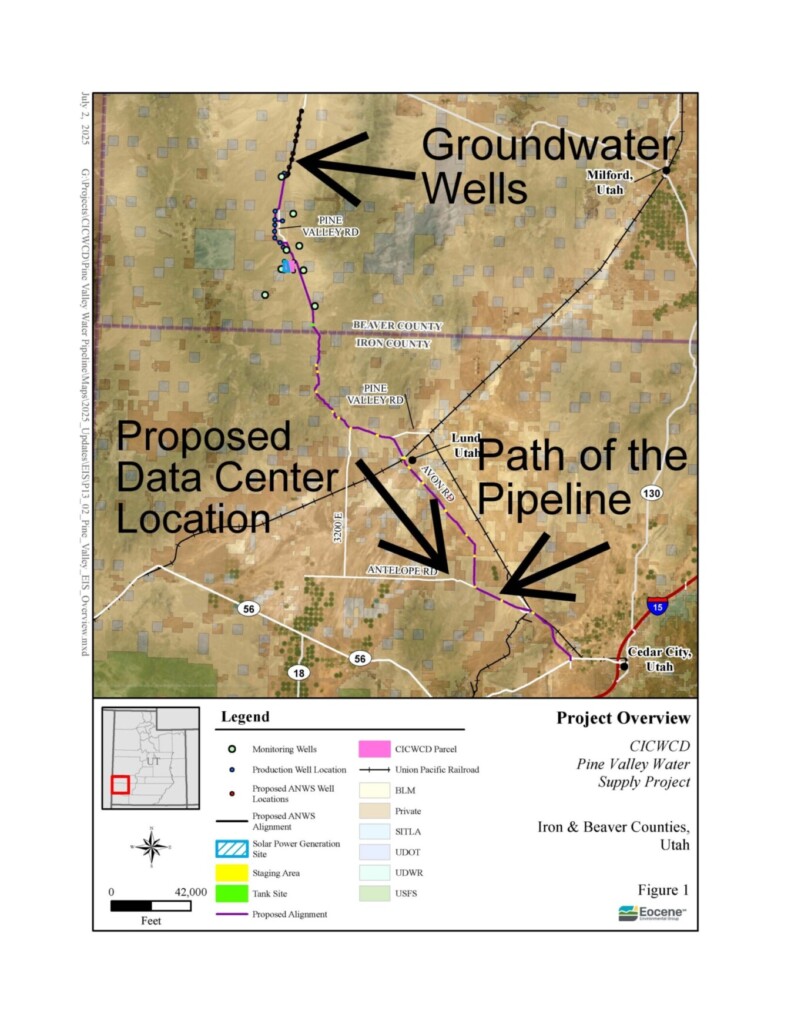
Recent records in the Iron County Planning Commission show that a company, Pronghorn Development, wants to build a data center not far from the terminus of the proposed Cedar City Pipeline. The location of the proposal aligns with the pipeline effort (see map below).
Early this month, residents from the region showed up to a public meeting in droves to express concerns about the data center. With the drought and inflation, many residents were worried about the overall impacts and costs of the water and power necessary to run an operation of its kind.
While data center development across the globe raises questions about water demand in all communities, the natural gas costs are just as concerning. The power plant that’s being proposed for this project would go near the Iron County data center complex and be a consumer of water as well as new burden on ratepayers. It’s likely that the power plant would consume more water than the data center, according to materials released by the proponents. But water use estimates put out by the proponent are very rosy and not rooted in anything other than rhetoric at this time. Nevertheless, the company is not saying a word about the water necessary to run a fossil-fuel-driven power plant.
All data center water use is direct and indirect. And, in the case of this proposal for Cedar City, the direct (the data center itself) and the indirect (the power and energy supply for it) are worth considering in the context of the public rhetoric coming from water officials.
When the federal government erroneously approved the Cedar City Pipeline on March 2nd, it did so under the auspices of serving a community that will soon face state-imposed curtailments in hopes of stabilizing the Cedar Valley aquifer. But proposals for the data center complex and an ancillary power plant project belie the hollow rhetoric. There will be increasing use and less incentive for conservation while water users in other parts of the state have their aquifer systems harmed. Great Salt Lake Desert communities in Beaver, Millard, Juab, Tooele, and White Pine (NV) Counties will be left in the dust.